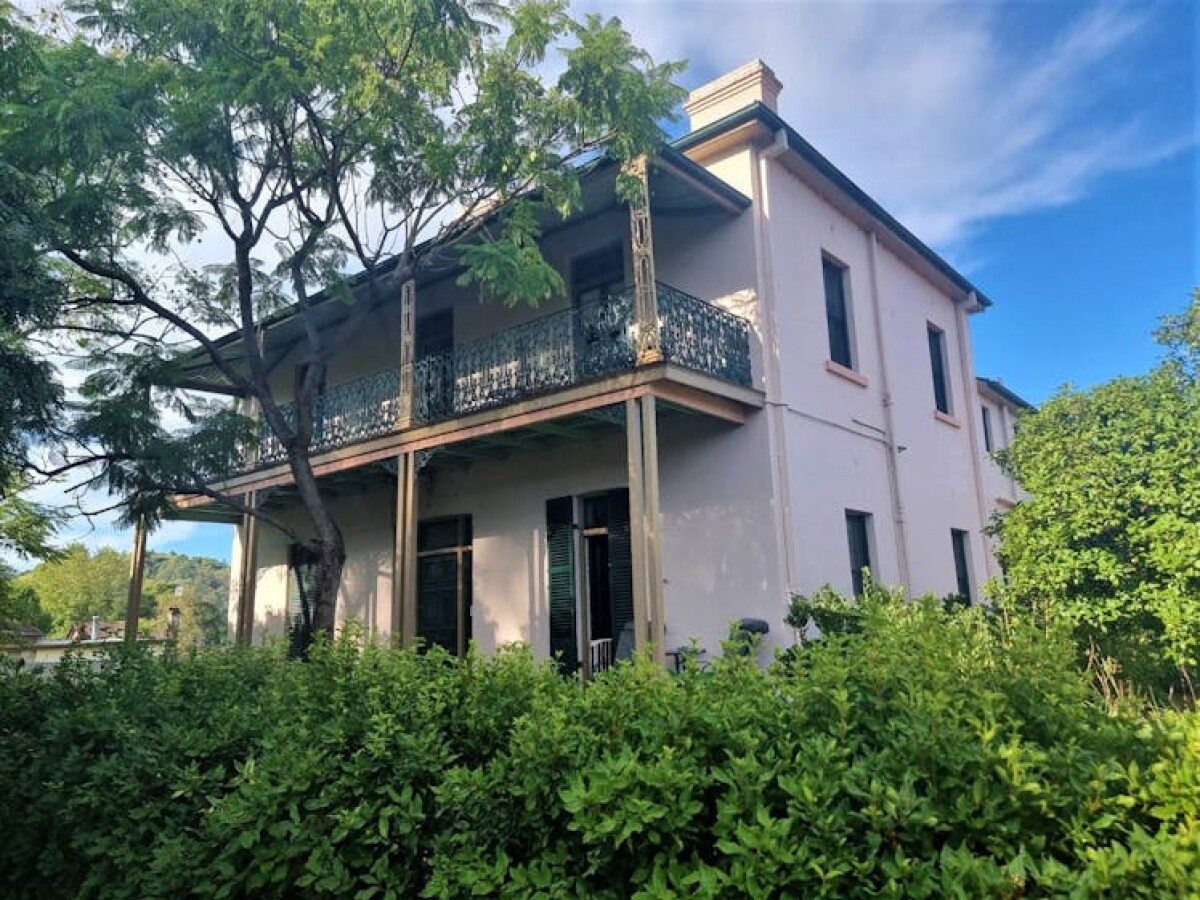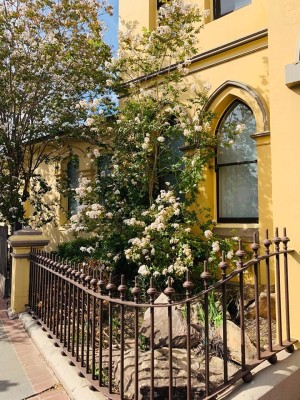
Wendover House
Wendover House – A Home with Deep Picton Connections
Wendover House is one of Picton's significant historic residences, standing on Menangle Street as a reminder of the people, businesses and changing lifestyles that have shaped the township. Its story reaches from the early development of Picton in the nineteenth century through to its use as a boarding house and its eventual conversion into flats.
From Jarvisfield to Picton
The story of this part of Picton begins with the 1822 land grant of Jarvisfield, awarded to Major Henry Colden Antill. At the time, the area was known as Stonequarry, after Stonequarry Creek, a name recorded as early as 1798.
Major Antill began establishing his vision for a private town in 1841, and it was around this time that the name Picton came into use.
The land on which Wendover House stands comprised Lots 12, 13 and 14 of Section 4. These were purchased in 1862–63 for £140 by Irish-born Arthur McQuiggin, who had emigrated to the colony in 1851.
McQuiggin had arrived in Picton by 1853, initially working as a police constable. He later became a storekeeper and built up a substantial property portfolio, purchasing several blocks throughout the growing township.
His youngest son, John Wright McQuiggin, inherited the Menangle Street properties. By the time Arthur died in 1879, the value of these properties had risen to approximately £1,650, suggesting that Wendover House had been constructed by this time.
The McQuiggin Family and Picton's First Mayor
John McQuiggin became an important figure in Picton's civic development. He married Alma James in 1886, and their only child, Arthur, was born in 1888.
John was elected to the first Picton Town Council and in 1895 became Picton's first Mayor. He remained involved in local government until his retirement from Council in 1912.
His contribution to Picton extended beyond municipal affairs. As one of the town's prominent residents, his family was closely connected to the development of the community during a period when Picton was establishing itself as an important commercial and administrative centre.
Alma also played an active role in the community. During World War I, she was particularly involved with the Red Cross, contributing to the town's wartime efforts. Later Alma worked successfully to allow women onto the Picton School of Arts committee.
John died in 1922 and Alma in 1934.
Wendover House and Picton's Banking History
One of the lesser-known chapters in Wendover House's story is its connection to the Commercial Banking Company of Sydney (CBC).
The CBC began operating in Picton during the late 1870s, initially using temporary premises around the town. The bank's first manager, Mr Styles, arrived in 1877 and is associated with the George IV Inn, while his successor Walter S. Burt may have operated from the Royal Hotel before the bank moved to other premises.
As the bank's business expanded, Wendover House on Menangle Street became one of its temporary locations during the 1880s. The building therefore formed part of Picton's early commercial network at a time when the township was developing into an important regional centre.
The bank's eventual move to a purpose-built premises on the corner of Menangle and Argyle Streets marked another stage in Picton's commercial development. Under manager George M. Webster, the new bank building was constructed in 1884–85.
The connection between Wendover House and the CBC is particularly significant because it links a private residence directly with one of Picton's most important historic commercial institutions.
From Family Home to Boarding House
After its association with the McQuiggin family and the CBC, Wendover House entered another important phase.
For several years, the property was rented to Mrs Murphy, who operated it as a boarding house. Boarding houses provided an important form of accommodation in country towns, particularly for single people who moved for employment.
The property was sold in 1939, and in 1940 Alfred Tyson Wonson, his wife Gladys and their children Aubrey - known as Rex - Audrey and Violet moved into the house. The family continued operating it as a boarding house.
Alfred had previously managed the Byrnes Exhibition Dairy at Abbotsford, just outside Picton, from 1928 until his retirement in 1939. At Wendover, he enjoyed having space for his garden.
Alfred died in 1949, but Gladys and Rex continued welcoming boarders after Audrey and Violet married in the early 1950s.
A Home for a Changing Workforce
The boarding-house years provide an interesting insight into everyday life in twentieth-century Picton.
At the time, it was common for single workers to live in boarding houses, particularly those whose employment required them to move regularly between towns. Teachers and bank tellers were among those who frequently became boarders, often staying for only a few years before being transferred elsewhere.
Wendover House therefore became a temporary home for a succession of residents, reflecting the changing workforce and social life of Picton.
For these residents, the house offered more than a room - it provided a place to live and connect with the local community while they worked in the district.
A New Chapter
Following Rex's death in 1970, Gladys moved in with her widowed daughter Audrey, and the property was subsequently sold.
By 1976, Wendover House had been divided into six flats, adapting the substantial historic residence to changing housing needs.
The property was later purchased in the late 1980s by Deenkiess Pty Ltd. Development proposals have subsequently provided for new residential buildings behind the historic house, while Wendover House remains an important heritage element of the site.
A Building That Reflects Picton's Changing Story
Wendover House offers a fascinating glimpse into the layers of Picton's history.
Its story encompasses the early Jarvisfield land grant, the creation of Picton as a private town, the rise of local families and civic leadership, the establishment of banking services, the changing nature of employment and the evolution of residential accommodation.
The building's association with John Wright McQuiggin, Picton's first Mayor, provides an important connection to the beginnings of local government. Its later role as temporary premises for the Commercial Banking Company of Sydney connects it to Picton's commercial history, while its decades as a boarding house reveal something of the everyday lives of ordinary residents.
Today, Wendover House remains a quiet witness to these changes - a historic home that has continually adapted to the needs of the people and town around it.
Information and historic photographs courtesy of the Picton & District Historical & Family History Society Inc.